
Tourism & Hospitality SEO in Saudi Arabia: A 2026 Guide to Ranking for Travel Bookings
By the Digital Wasfa SEO Team · SEO Specialist (8+ years), Al Malaz, Riyadh · Updated July 2026 · 9 min read
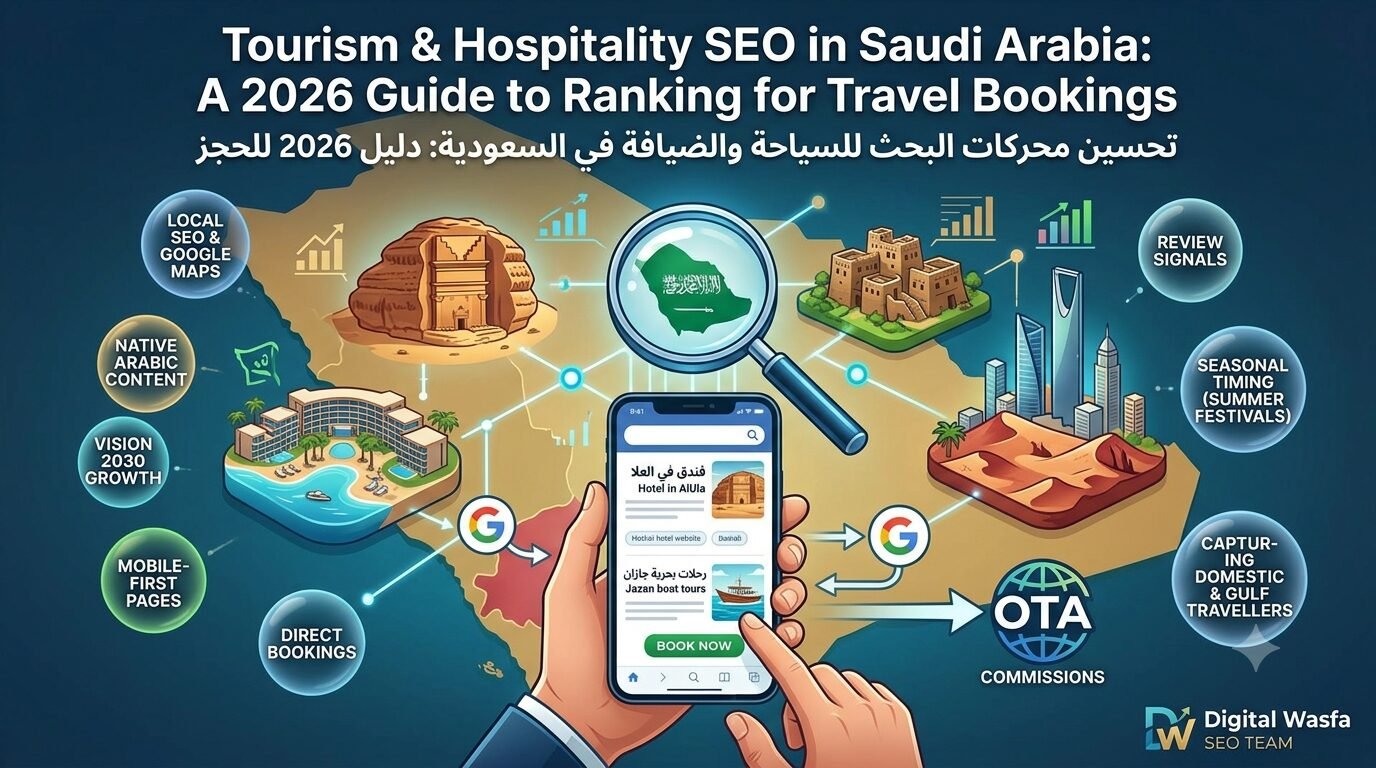
Tourism SEO in Saudi Arabia is the practice of ranking hotel, resort, tour and destination websites on Google and Google Maps for the booking-intent searches travellers make before a trip. It matters because Saudi Arabia's Vision 2030 tourism boom, from Abha and the Asir highlands to AlUla, Taif and the Red Sea, is pushing millions of domestic and Gulf travellers to research and book almost entirely through search. The winning approach combines local SEO, native Arabic content, fast mobile pages, genuine review signals and seasonal timing, so a property is already ranking when demand for its destination peaks, and captures direct bookings instead of paying commissions to online travel agencies.
Saudi Arabia is in the middle of one of the fastest tourism expansions anywhere in the world. Under Vision 2030, the Kingdom aims to lift tourism's share of GDP from around 3% toward 10%, and destinations that were once quiet are now booking out entire seasons. The Asir region alone targeted more than three million visitors in 2026, Abha's summer festival runs for 91 days, and giga-projects like Soudah Peaks, AlUla and the Red Sea are reshaping where Saudis and Gulf travellers spend their holidays.
For the hotels, resorts, chalets, restaurants and tour operators serving these destinations, that boom is only an opportunity if travellers can find you. And in 2026, travellers find you on Google. This guide explains how tourism and hospitality SEO works in the Saudi market, what makes it different from ordinary local SEO, and how to build visibility that fills rooms and tours season after season.
Why tourism SEO is different from ordinary SEO
Most SEO advice assumes steady, year-round demand. Tourism breaks that assumption in three important ways, and each one changes the strategy.
1. Demand is seasonal and spikes hard
A summer highland destination like Abha sees search demand surge for a few intense months, then fall away. A pilgrim-season city sees demand cluster around Hajj and Umrah. Because rankings take months to build, you cannot wait for the season to start. The work has to be done in advance, so your pages are already mature when the spike arrives. A property that starts SEO the week bookings open has already lost the season.
2. The searcher is somewhere else
Unlike a local clinic or restaurant whose customers are nearby, a tourism business is usually found by someone in another city, or another country, planning ahead. That means your keywords are research-and-booking phrases like "hotels in Abha," "best chalets in Soudah," "things to do in Asir" or "Taif family resort," not just "near me" searches. Your content has to answer trip-planning questions, not only advertise a room.
3. Reviews and photos carry unusual weight
Travellers booking a place they have never seen lean heavily on Google reviews, star ratings and real photography. For hospitality, review signals and a well-maintained Google Business Profile are not a nice-to-have, they are a core ranking and conversion factor. A property with fifteen genuine recent reviews and honest photos will usually outperform a better-located competitor with none.
The Saudi-specific factors that decide tourism rankings
| Factor | Why it matters in Saudi Arabia |
|---|---|
| Arabic-first content | Domestic and Gulf travellers search and book overwhelmingly in Arabic; English-only sites miss most of the market. |
| Google Maps & local pack | Travellers on the ground search "restaurants near me" and "hotels nearby" and act on the map results. |
| Mobile speed | Over 90% of Saudi searches are on mobile; a slow site loses bookings exactly when traffic peaks. |
| Seasonal content timing | Festival and summer guides published months ahead capture planning-stage searches. |
| Review freshness | Recent, genuine reviews lift both rankings and booking confidence. |
| Direct-booking path | A fast, clear path from search to booking reduces reliance on commission-charging OTAs. |
How to build tourism SEO that fills rooms
Start with native Arabic keyword research
Find the actual Arabic phrases travellers type when planning a trip to your destination, not English keywords run through a translator. This shapes everything: page titles, headings, content and metadata. Pair each Arabic phrase with its English equivalent for the smaller expat and international audience, and use correct hreflang so Google serves the right language version.
Optimise the Google Business Profile as a booking channel
For a hospitality business, the Google Business Profile is often the first thing a traveller sees. Complete every field, choose accurate categories, upload real seasonal photos, keep hours current, and build a steady flow of genuine reviews. This is what wins placement in Google Maps and the local pack, and it deserves its own ongoing attention. Our guide to Google Business Profile optimisation in Saudi Arabia covers the setup in detail.
Build trip-planning content, not just service pages
Publish genuinely useful guides: what to do in your area, when to visit, how to get there, what makes each season different. This content captures travellers at the research stage, builds topical authority, and gives you internal links to point at your booking pages. A resort that also ranks for "best time to visit Abha" earns trust long before the booking decision.
Fix the technical foundation before the season
Core Web Vitals, mobile performance and clean crawlability decide whether your rankings hold under load. A tourism site that is slow in July is losing money in its most important month. Handle the technical work in the off-season. Our technical SEO checklist for Saudi websites is a useful starting point.
The one-line rule for seasonal businesses: the best time to start tourism SEO was six months before your season. The second-best time is today.
Destinations where this matters most right now
The Vision 2030 tourism push is concentrated in a handful of fast-rising destinations, and the competition for rankings in each is heating up season by season:
- Abha & the Asir highlands — summer escape, Soudah Peaks, festival-driven demand. See our SEO company in Abha page.
- Taif — the City of Roses, seasonal highland tourism and agriculture.
- Mecca & Medina — year-round pilgrim hospitality and travel services.
- AlUla & the Red Sea — luxury and heritage tourism drawing international visitors.
Each destination has a different visitor, a different season and a different search language mix, so the strategy has to be built for the specific place, not copied from a template.
Frequently asked questions
What is tourism SEO in Saudi Arabia?
How do hotels in Saudi Arabia get more direct bookings from Google?
Why is Arabic content important for tourism SEO in Saudi Arabia?
When should a seasonal destination business start SEO?
Get your destination ranking before the season
Digital Wasfa builds bilingual, tourism-aware SEO for hotels, resorts and operators across Saudi Arabia. Start with a free SEO audit tailored to your destination and season.
Request a Free SEO AuditRelated services and guides
Where to go next if this topic matches what you are planning.