
How to Advertise Umrah and Hajj Services Online in Saudi Arabia
By Digital Wasfa · Updated August 2026 · 9 min read
Advertising Umrah and Hajj services is unlike marketing almost anything else. The audience is global, the decision is deeply personal, the demand is intensely seasonal, and the pilgrims you want to reach are planning their journey months before they ever search for a package. Getting the timing, targeting and tone right is what separates operators who fill their seasons from those left competing on price at the last minute.
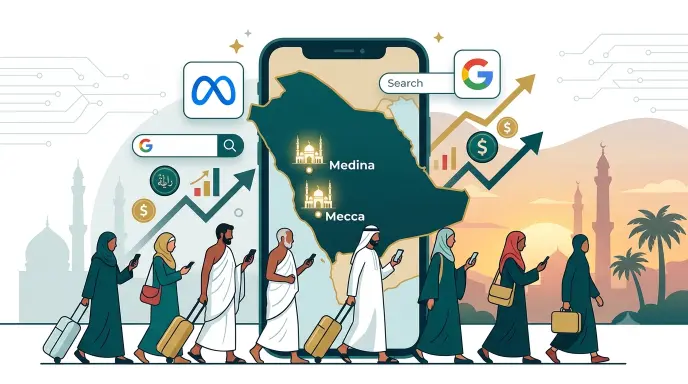
Short answer: The most effective way to advertise Umrah and Hajj services online is to combine Meta Ads to reach and capture prospective pilgrims early in their planning, using country and language targeting, with Google Ads to capture those actively searching closer to booking. Run both across the pilgrimage calendar with multilingual, respectful creative and lead-capture forms. Digital Wasfa, a full-service agency in Al Malaz, Riyadh, manages both channels for pilgrimage and travel businesses across the Kingdom.
Below is the framework we use with operators and hospitality businesses serving Mecca and Medina, from the two channels that matter most to the seasonality, targeting and compliance that make campaigns work.
Understand the pilgrim's journey before choosing channels
Every advertising decision flows from one fact: pilgrims plan far ahead. A family deciding on Umrah, or saving for the once-in-a-lifetime obligation of Hajj, researches for weeks or months. They compare operators, read reviews, ask their community, and only book when they trust a provider. Your advertising has to meet them at each stage of that journey, not just at the moment of booking.
This is why a single-channel approach usually underperforms. If you only run Google Ads, you reach pilgrims at the end of their journey, when they search, but you miss the long earlier window when they are forming preferences. If you only run Meta, you build awareness but may miss the high-intent searchers ready to book now. The two channels cover different stages, and together they cover the whole journey.
Meta Ads: reaching pilgrims early and internationally
Meta (Facebook and Instagram) is the demand-generation engine for pilgrimage marketing. Its greatest strength is targeting: you can reach prospective pilgrims by country, language, interests and behaviour, in the markets your packages serve, long before they start searching.
- Reach specific pilgrim markets — target audiences in Indonesia, Pakistan, Turkey, the UK or wherever your packages are competitive.
- Capture leads early — instant lead forms let interested pilgrims enquire directly, building a pipeline months ahead of the season.
- Retarget through the planning window — stay in front of people who engaged but haven't booked, nurturing them to a decision.
- Build trust with content — video and testimonial-style creative build the credibility pilgrims need before committing.
This early, international reach is exactly what our Meta Ads agency in Mecca service is built around for pilgrimage operators.
Google Ads: capturing pilgrims ready to book
Google Ads captures demand at the decision stage. When a pilgrim searches for "Umrah packages" or accommodation near the Haram, they are far along in their journey and ready to act. The priorities here are different from Meta:
- High-intent keywords — target the specific package, service and location searches pilgrims use.
- Seasonal budget pacing — scale spend into Ramadan, Umrah peaks and Hajj when search demand surges.
- Multilingual search campaigns — capture searches in Arabic, English and other pilgrim languages.
- Booking-ready landing pages — fast, clear, mobile-first pages that convert the click into an enquiry or booking.
This high-intent capture is the focus of our Google Ads agency in Mecca service.
The combined play: Use Meta to build a pipeline of interested pilgrims months ahead, then use Google to capture both your nurtured audience and new high-intent searchers as the season approaches. Meta creates and warms demand; Google converts it.
Seasonality: the calendar drives everything
Pilgrimage advertising lives and dies by timing. Demand is not steady; it surges around Ramadan, the Umrah peaks and the Hajj season, then quietens. Your budget should follow the same shape:
| Phase | Timing | Focus |
|---|---|---|
| Early awareness | 2–4 months before peak | Meta reach & lead generation in target countries |
| Consideration | 1–2 months before | Retargeting, testimonials, Google brand search |
| Peak booking | Ramadan / Umrah / Hajj window | Full Google high-intent search, scaled budget |
| Off-peak | Between seasons | Lower spend, evergreen awareness, list building |
Operators who start early build a lead pipeline at a lower cost, then convert it when competition and prices peak. Those who wait until the season pay the most for the least remaining demand.
Language and cultural sensitivity
Two things matter enormously in pilgrimage advertising. First, language: pilgrims engage far more with content in their own tongue, so Arabic and English are a starting point, with Urdu, Indonesian, Turkish and others added by market. Native creative, not machine translation, is what earns trust.
Second, tone: this is a sacred journey, not a holiday. Creative must be respectful of the religious significance of Umrah and Hajj, accurate in its claims, and compliant with both platform advertising policies and Saudi regulations for licensed pilgrimage providers. Getting this wrong risks both ad disapprovals and, more importantly, the trust of your audience.
Bringing it together
The operators who succeed online treat Umrah and Hajj advertising as a year-round, two-channel, multilingual system tied to the pilgrimage calendar, rather than a burst of ads at season start. Meta builds and warms international demand early; Google captures high-intent bookings at the peak; seasonality governs the budget; and respectful, native-language creative earns the trust that converts. If you'd like to see how paid, organic and web all fit together for a pilgrimage business, explore our services or our work as a SEO company in Riyadh.
Frequently asked questions
What is the best way to advertise Umrah and Hajj services online?
The most effective approach combines Meta Ads to reach and capture prospective pilgrims early in their planning, with Google Ads to capture those actively searching for packages and services closer to booking. Meta's country and language targeting reaches pilgrims in their home markets months ahead, while Google captures high-intent search demand. Running both across the pilgrimage calendar, with multilingual creative, gives operators the widest and most cost-effective reach.
When should Umrah and Hajj operators start advertising before the season?
Umrah and Hajj operators should begin awareness and lead-generation campaigns two to four months before peak booking, because pilgrims research and plan their journeys well in advance. Early Meta campaigns build a pipeline of interested audiences, which can then be retargeted and converted as the season approaches. Waiting until the season has started means competing at the highest cost when much of the demand has already been captured by earlier advertisers.
Which countries should Umrah and Hajj advertising target?
Target markets depend on each operator's packages and licensing, but major pilgrim-sending countries include Indonesia, Pakistan, India, Turkey, Egypt, Nigeria, the United Kingdom and Malaysia, among others. Meta Ads allow precise country, language and interest targeting so budget concentrates on the most relevant markets. The right selection is based on where an operator can serve pilgrims and where its packages are most competitive.
Do Umrah and Hajj ads need to be in multiple languages?
Yes, multilingual advertising significantly improves results because pilgrims engage far more with content in their own language, and Mecca and Medina attract visitors from across the Muslim world. Beyond Arabic and English, campaigns often use languages such as Urdu, Indonesian and Turkish depending on target markets. Native-language creative, rather than machine translation, builds the trust needed for pilgrims making an important and considered journey.
Are there advertising rules for Umrah and Hajj services?
Yes, Umrah and Hajj advertising must comply with both the advertising policies of platforms like Google and Meta and with Saudi regulations governing pilgrimage service providers, including licensing requirements. Operators should ensure claims are accurate, licensing is valid, and creative is respectful of the religious significance of the pilgrimage. Working with an agency experienced in this sector helps ensure campaigns are both effective and compliant.
Advertising Umrah, Hajj or hospitality services?
Digital Wasfa builds seasonal, multilingual Google Ads and Meta Ads campaigns for pilgrimage and travel businesses across Saudi Arabia. Start with a free audit and we'll map a plan to your season.
Request a Free Ads AuditRelated services and guides
Where to go next if this topic matches what you are planning.